
This is a photograph of the incorruptible body of Padre Pio exhumed on March 2, 2008, 40 years after his death on September 23, 1968. His remains was shown to the public in the Shrine of Holy Mary of Grace, Madonna delle Grazie Church in San Giovanni Rotondo, Foggia province, Italy, from April 24, 2008 to September 2009. Padre Pio was a Franciscan Capuchin Catholic priest who bore the five wounds of Jesus Christ on his body visibly for more than fifty years. He was also a seer, mind-reader, prophet, miracle-worker, confessor, mystic, ascetic, and a missionary on a world-wide scale.
There have only been about 60 accepted cases of the stigmata in the Catholic Church’s history. Padre Pio was the first and only ordained Roman Catholic priest in the Church's history who has received the visible stigmata. According to medical science, his loss of blood over the years was so great that he could not have survived for very long – certainly not fifty years.


There have only been about 60 accepted cases of the stigmata in the Catholic Church’s history. Padre Pio was the first and only ordained Roman Catholic priest in the Church's history who has received the visible stigmata. According to medical science, his loss of blood over the years was so great that he could not have survived for very long – certainly not fifty years.
Padre Pio had wounds on the hands and feet, on the left side of the chest, and on the right shoulder were Jesus carried the Cross. He also had transverberation of the heart, wounds from scourging, and an invisible crown of thorns. All were very painful.
Padre Pio actually received the stigmata on August 14, 1910. According to Padre Pio's correspondence, even early in his priesthood he experienced less obvious indications of the visible stigmata for which he would later become famous. In a 1911 letter to his spiritual director, Padre Benedetto from San Marco in Lamis, Padre Pio described something he had been experiencing for a year:
Padre Pio actually received the stigmata on August 14, 1910. According to Padre Pio's correspondence, even early in his priesthood he experienced less obvious indications of the visible stigmata for which he would later become famous. In a 1911 letter to his spiritual director, Padre Benedetto from San Marco in Lamis, Padre Pio described something he had been experiencing for a year:
"Then last night something happened which I can neither explain nor understand. In the middle of the palms of my hands a red mark appeared, about the size of a penny, accompanied by acute pain in the middle of the red marks. The pain was more pronounced in the middle of the left hand, so much so that I can still feel it. Also under my feet I can feel some pain."

His close friend Father Agostino wrote to him in 1915, asking when he first experienced visions, whether he had been granted the stigmata, or felt the pains of the Passion of Christ - the crowning of thorns and the scourging. Padre Pio replied that he had been favoured with visions since his novitiate period (1903 to 1904). He wrote that although he had been granted the stigmata, he had been so terrified by the phenomenon he begged the Lord to withdraw only the visible wounds but not the pain since at the time he considered them to be an indescribable and almost unbearable humiliation. The visible wounds disappeared at that point, but reappeared in September 1918. He reported, however, that the pain remained and was more acute on specific days and under certain circumstances. He also admitted experiencing the pain of the crown of thorns and the scourging. He was not able to clearly indicate the frequency of this experience, but said that he had been suffering from them at least once weekly for some years.
On July 1918, while World War I was still going on, Pope Benedict XV, who had termed the World War "the suicide of Europe," appealed to all Christians urging them to pray for an end of the war. On 27 July of the same year, Padre Pio offered himself as a victim for the end of the war. Days passed and between August 5 and 7, Padre Pio had a vision in which Christ appeared and pierced his side. This occurrence is considered as a "transverberation" or piercing of the heart indicating the union of love with God.
In a letter to Father Benedetto on August 21, 1918, Padre Pio writes of his experiences during the transverberation:
"While I was hearing the boys’ confessions on the evening of the 5th (August), I was suddenly terrorized by the sight of a celestial person who presented himself to my mind’s eye. He had in his hand a sort of weapon like a very long sharp-pointed steel blade which seemed to emit fire. At the very instant that I saw all this, I saw that person hurl the weapon into my soul with all his might. I cried out with difficulty and felt I was dying. I asked the boy to leave because I felt ill and no longer had the strength to continue. This agony lasted uninterruptedly until the morning of the 7th. I cannot tell you how much I suffered during this period of anguish. Even my entrails were torn and ruptured by the weapon, and nothing was spared. From that day on I have been mortally wounded. I feel in the depths of my soul a wound that is always open and which causes me continual agony."

With his transverberation began another seven-week long period of spiritual unrest for Padre Pio. One of his Capuchin brothers said this of his state during that period: "During this time his entire appearance looked altered as if he had died. He was constantly weeping and sighing, saying that God had forsaken him."
On September 20, 1918, the pains of the transverberation had ceased and Padre Pio was in "profound peace." On that same day, after celebrating Mass, and while Padre Pio was praying his thanksgiving in the choir loft in the Church of Our Lady of Grace, the same Being who had appeared to him in August and given him the transverberation, and who is believed to be the Wounded Christ, appeared again and Padre Pio had another experience of religious ecstasy. When the ecstasy ended, Padre Pio had received the visible Stigmata - the five wounds of Christ, which became permanent and would stay on him for the next fifty years of his life.
In a letter to Father Benedetto on October 22, 1918, Padre Pio describes his experience of receiving the Stigmata:
"On the morning of the 20th of last month, in the choir, after I had celebrated Mass I yielded to a drowsiness similar to a sweet sleep. [...] I saw before me a mysterious person similar to the one I had seen on the evening of 5 August. The only difference was that his hands and feet and side were dripping blood. This sight terrified me and what I felt at that moment is indescribable. I thought I should have died if the Lord had not intervened and strengthened my heart which was about to burst out of my chest. The vision disappeared and I became aware that my hands, feet and side were dripping blood. Imagine the agony I experienced and continue to experience almost every day. The heart wound bleeds continually, especially from Thursday evening until Saturday. Dear Father, I am dying of pain because of the wounds and the resulting embarrassment I feel deep in my soul. I am afraid I shall bleed to death if the Lord does not hear my heartfelt supplication to relieve me of this condition. Will Jesus, who is so good, grant me this grace? Will he at least free me from the embarrassment caused by these outward signs? I will raise my voice and will not stop imploring him until in his mercy he takes away, not the wound or the pain, which is impossible since I wish to be inebriated with pain, but these outward signs which cause me such embarrassment and unbearable humiliation."
Padre Pio quoted, "The pain was so intense that I began to feel as if I were dying on the cross."
 |
| The Crucifix from which Padre Pio received the stigmata located in the choir loft of Our Lady of Grace Church. |
Padre Pio was 31 years old when he received the stigmata. The stigmata which he bore were very deep wounds at the center of his hands and feet and on the left side of his body. His hands and feet were pierced all the way through, one could even see light through the membrane that covered his wounds. He wore half-gloves over his hands that would leave his fingers free (except during Mass), and stockings on his feet. The bandage that covered his side wound which was soaked with blood during the night, had to be changed the following morning.
When asked why the wound in his side was in a slightly different place than the place where Our Lord’s wound was, Padre Pio responded, "It would be too much if it were exactly like the Lord’s." Besides the stigmata, Padre Pio suffered the crowning with thorns and the flagellation almost once a week.
On several occasions, by order of Padre Pio's Superiors, the Holy Office, and the Pope, his stigmata was examined by medical doctors and prelates who all found his wounds unexplainable and miraculous. Without direct permission of his superiors, no one was able to see the wounds. Professor Amico Bignami, professor of medical pathology at the University of Rome, examines Padre Pio on July 12, 1919, upon request by Padre Giuseppe da Persiceto, General Procurator of the Capuchin Order: ". . . I do not understand how these wounds have persisted for nearly a year now without getting better or worse." Padre Pio’s wounds on his hands were often open and exposed, but remained completely free from infection. He lost about a cup-full of blood every day from the wound on his side, which was covered always by a linen cloth. Another doctor, Dr. Sanguinetti, told a friend, "If you or I would suffer one-tenth of the pain that Padre Pio suffers from his wounds, we’d be dead."

Dr. Luigi Romanelli, head surgeon of the hospital in Barletta, examined Padre Pio 5 times between May 15,1919 and July 1920 by disposition of Padre Benedetto di San Marco in Lamis, Provincial Superior of the Capuchins. "The lesions on the hands are covered by a red brown membrane, without bleeding, no edema and no inflammation of the surrounding tissues. I am certain that these wounds are not superficial because, putting my thumb in the palm of the hand, and the index finger on the back, and applying pressure, I have the exact perception of a void existing." "The etiology of the lesions of Padre Pio is not natural. The agent producing those lesions needs to be searched, make no mistakes, in the supernatural. The fact in itself it's a phenomenon that cannot be explained with the sole human science."
Prof. Giorgio Festa, a private practitioner, examined the wounds on 3 occasions: the first on October 28, 1919, upon request by Padre Venanzio da Lysle, Superior General of the Capuchin Order, and the second from July 9 to 15, 1920 together with Dr. Luigi Romanelli. The third was on September 28, 1925. Benedict XV was the pope when Padre Pio received the wounds in 1918. Pope Benedict XV sent Archbishop Anselm Edward Kenealy, of Simla, India, who was himself a Capuchin and a prelate. He examined Padre Pio on March 24-27, 1920: "I am deeply convinced that we have a true saint here. The Lord has given him great gifts, and he is completely at ease. If he knows how to suffer, he also knows how to laugh." Not completely satisfied, the pope sent Archbishop Bonaventura Cerretti to examine Padre Pio. He too was deeply impressed, and gave the pope a very positive evaluation.
On July 20, 1920, Professor Giuseppe Bastianelli, physician to Pope Benedict XV agreed that the wounds existed but made no other comment. Pathologist Dr. Amico Bignami of the University of Rome also observed the wounds but could make no diagnosis. Both Bignami and Dr. Giuseppe Sala commented on the unusually smooth edges of the wounds and lack of edema. Dr. Alberto Caserta took X-rays of the hands in 1954 and found no abnormality in the bone structure.
At times, the blood around the stigmata gave off a pleasant fragrance "like a mixture of violets and roses." One doctor added, "One should consider that of all the parts of the human organism, blood is the quickest to decompose. In any case blood never gives off a pleasant odor." This miraculous pleasant fragrance was also smelled on things that belonged to Padre Pio and on some things that he touched. Some devotees of Padre Pio have smelled a pleasant fragrance, roses, wild flowers, or a cigar smoke scent. They believe this indicates his presence, a warning, or a message of some kind.
Prof. Giorgio Festa, a private practitioner, examined the wounds on 3 occasions: the first on October 28, 1919, upon request by Padre Venanzio da Lysle, Superior General of the Capuchin Order, and the second from July 9 to 15, 1920 together with Dr. Luigi Romanelli. The third was on September 28, 1925. Benedict XV was the pope when Padre Pio received the wounds in 1918. Pope Benedict XV sent Archbishop Anselm Edward Kenealy, of Simla, India, who was himself a Capuchin and a prelate. He examined Padre Pio on March 24-27, 1920: "I am deeply convinced that we have a true saint here. The Lord has given him great gifts, and he is completely at ease. If he knows how to suffer, he also knows how to laugh." Not completely satisfied, the pope sent Archbishop Bonaventura Cerretti to examine Padre Pio. He too was deeply impressed, and gave the pope a very positive evaluation.
On July 20, 1920, Professor Giuseppe Bastianelli, physician to Pope Benedict XV agreed that the wounds existed but made no other comment. Pathologist Dr. Amico Bignami of the University of Rome also observed the wounds but could make no diagnosis. Both Bignami and Dr. Giuseppe Sala commented on the unusually smooth edges of the wounds and lack of edema. Dr. Alberto Caserta took X-rays of the hands in 1954 and found no abnormality in the bone structure.
 |
| Palm of Right Hand |
On June 14, 1921, Bishop Raffaello Carlo Rossi of Volterra, future cardinal, was sent as secret investigator by the Holy Office. Excerpts from his written report the, Bishop stated:
"The very intense and pleasant fragrance, similar to the scent of the violet, I have smelled it." "I have examined the monk's cell and could find nothing that would cause such a scent. There was only plain soap."
Padre Pio told Bishop Rossi under oath: "On September 20, 1918 I saw the Lord. I heard this voice: 'I unite you with my Passion.' Once the vision disappeared, I came to, I returned to my senses, and I saw these signs here, which were dripping blood. I didn't have anything before."
Bishop Rossi: "The stigmata are there: We are before a real fact - it is impossible to deny." "I am fully in favor of their authenticity, and, in fact, of their Divine origin." "The future will reveal what today cannot be read in the life of Padre Pio of Pietrelcina."
 |
| Palm of Left Hand |
Everybody that had seen the wounds agreed: "The marks appear both in the palm and back of the hands. They are circular and a little more than two centimeters in diameter. They are reddish brown in color and sharply marked off from the surrounding skin which is perfectly normal and without any sign of inflammation. A dark looking scab covers the wounds, which detaches itself from time to time. Exactly similar lesions appear in the instep and sole of each foot. The wound in the breast is cruciform, and on the left side.The bleeding is not periodic, but seems to be a continuous exudation of saunguino-serous fluid from all the wounds especially from the breast."
In 1947, Karol Wojtyla, who later became John Paul II, asked Padre Pio which of his wounds caused the greatest suffering. Padre Pio answered, "It is my shoulder wound, which no one knows about and has never been cured or treated."
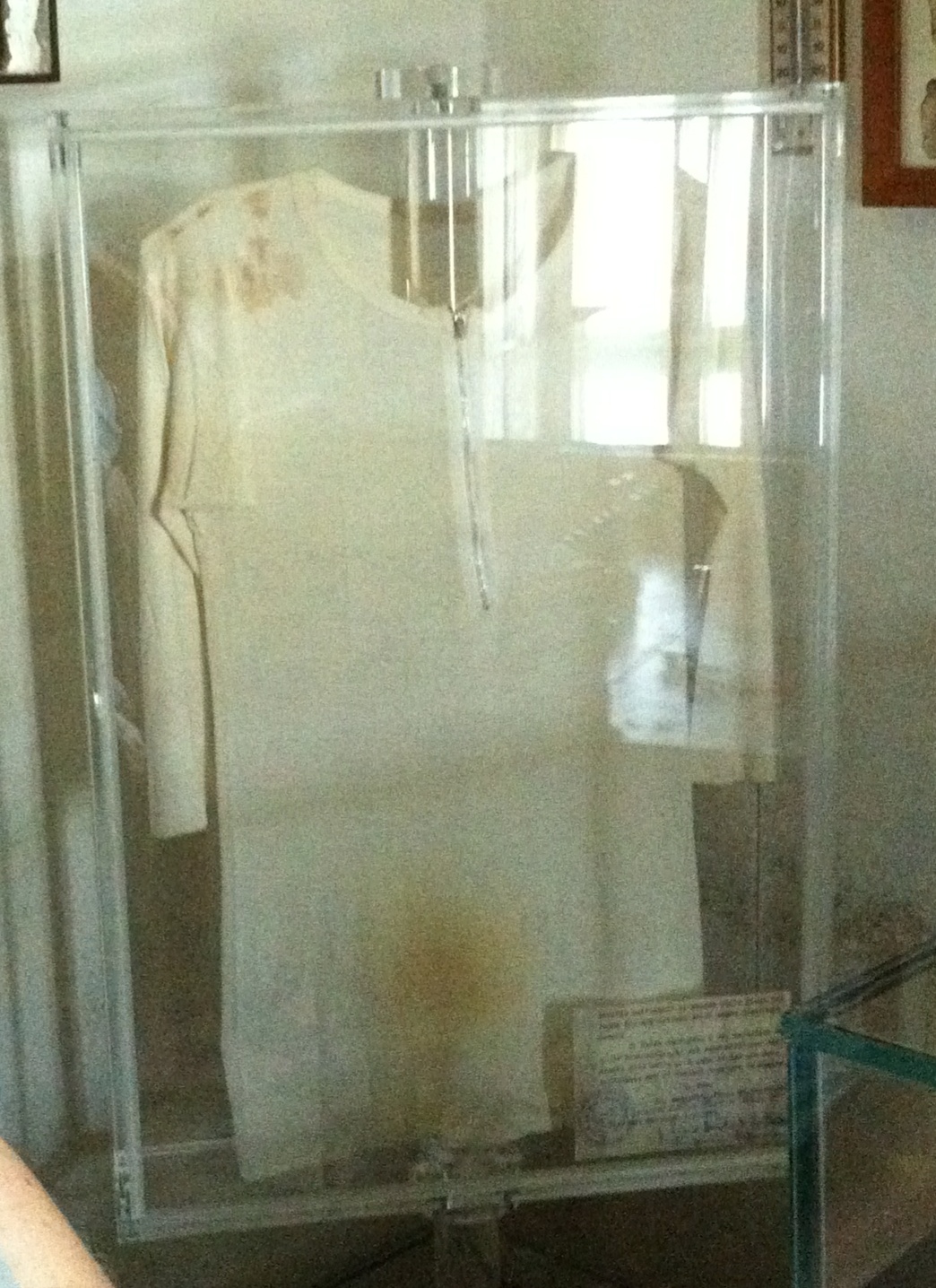 |
| Undershirt of Padre Pio which bears bloody stains on right shoulder |
Early Life
Born Francesco Forgione on May 25, 1887 to parents: Grazio Mario Forgione (1860–1946) and Maria Giuseppa de Nunzio Forgione (1859–1929) in Pietrelcina, a farming town in Campania region, 8 miles from Benevento, southern Italy, Padre Pio was the fourth of seven children. His parents made a living as peasant farmers. He was baptized in the nearby St. Anna's church on May 26, 1887, the day after his birth. His siblings were an older brother, Michele, and three younger sisters, Felicita, Pellegrina, and Grazia who later become a Bridgettine nun. His parents had two other children who died in infancy.
 |
| Maria Giuseppa de Nunzio Forgione |
At a tender age of 5, he had already dedicated his entire life to God. At this time, he began to have visions - visions of holy things as well as visions of very evil things. These horribly evil visions scared him and caused him to cry. Francesco was a meditative and docile child. He did not like to go out and play with children his age because, as he said, "They are not honest; they use bad language, and they swear." It was second nature for Francesco, when around girls, to control his eyes modestly, keep his head somewhat inclined, act very reserved, and avoid becoming too familiar with them. One time, he saw a girl that he knew toiling away with her needle, sewing a band on a dress. He told her: "Andrianella, today we don’t work. It’s Sunday." Showing her annoyance, the girl replied, "Little boy, you are too small to talk like that." Francesco left her, and came back with a pair of scissors. He then grabbed the band she had been working on and cut it into pieces.
When he was nine years old, he begun inflicting penances on himself and his Mother discovered that he slept on the hard, cold stone floor with a stone as pillow. Until the age of 10, he assisted his parents looking after a small flock of sheep the family owned.
After he had completed three years at the public school, in 1897, Francesco was drawn to the life of a friar after listening to a young Capuchin friar who was, at that time, seeking donations in the countryside. When he expressed his desire to his parents, they made a trip to Morcone, a community 13 miles (21 km) north of Pietrelcina, to find out if their son was eligible to enter the Capuchin Order. The Friars there informed them that they were interested in accepting Francesco into their community, but he needed more educational qualifications.
Francesco's father went to the United States in search of work to pay for private tutoring for his son, so that he might meet the academic requirements to enter the Capuchin Order. It was in this period that Francesco received the sacrament of Confirmation on 27 September 1899. He underwent private tutoring and passed the stipulated academic requirements.
In 1901, when Francesco was fourteen, he was sent to work on a high school program under the direction of Angelo Caccavo. In 1902, Caccavo assigned Francesco the task of writing a paper entitled "If I Were King."
The fifteen year old Francesco wrote: "[If I Were King] I would fight, first against divorce, which so many wicked men desire, and make people respect as much as possible the sacrament of matrimony. What happened to Julian the Apostate, who was brave, self-controlled, and studious, but who made the big mistake of denying Christianity, in which he was educated, because he decided to revive Paganism? His life was wasted because he did not attain anything but the despicable name of apostate."
On 6 January 1903, at the age of 16, he entered the novitiate of the Capuchin Friars at Morcone (Benevento) where, on 22 January, he received the Franciscan habit taking the name of Brother Pio, in honor of Pope St. Pius V, the patron saint of Pietrelcina.
From Morcone he moved to Sant'Elia a Pianisi for high school, and subsequently to San Marco la Catola to study philosophy.
On January 1907, Brother Pio professed the solemn vows of poverty, chastity, and obedience and moved to Serracapriola to study theology under Father Agostino da San Marco, his spiritual director, and of Father Benedetto, head of the province. Both teachers were from San Marco in Lamis.
When he was nine years old, he begun inflicting penances on himself and his Mother discovered that he slept on the hard, cold stone floor with a stone as pillow. Until the age of 10, he assisted his parents looking after a small flock of sheep the family owned.
After he had completed three years at the public school, in 1897, Francesco was drawn to the life of a friar after listening to a young Capuchin friar who was, at that time, seeking donations in the countryside. When he expressed his desire to his parents, they made a trip to Morcone, a community 13 miles (21 km) north of Pietrelcina, to find out if their son was eligible to enter the Capuchin Order. The Friars there informed them that they were interested in accepting Francesco into their community, but he needed more educational qualifications.
 |
| Grazio Mario Forgione |
In 1901, when Francesco was fourteen, he was sent to work on a high school program under the direction of Angelo Caccavo. In 1902, Caccavo assigned Francesco the task of writing a paper entitled "If I Were King."
The fifteen year old Francesco wrote: "[If I Were King] I would fight, first against divorce, which so many wicked men desire, and make people respect as much as possible the sacrament of matrimony. What happened to Julian the Apostate, who was brave, self-controlled, and studious, but who made the big mistake of denying Christianity, in which he was educated, because he decided to revive Paganism? His life was wasted because he did not attain anything but the despicable name of apostate."
On 6 January 1903, at the age of 16, he entered the novitiate of the Capuchin Friars at Morcone (Benevento) where, on 22 January, he received the Franciscan habit taking the name of Brother Pio, in honor of Pope St. Pius V, the patron saint of Pietrelcina.
From Morcone he moved to Sant'Elia a Pianisi for high school, and subsequently to San Marco la Catola to study philosophy.
On January 1907, Brother Pio professed the solemn vows of poverty, chastity, and obedience and moved to Serracapriola to study theology under Father Agostino da San Marco, his spiritual director, and of Father Benedetto, head of the province. Both teachers were from San Marco in Lamis.
 |
| House where Padre was born in May 25, 1887 |
 |
| Inside Padre Pio's home |
 |
| St. Anna's Church where Padre Pio was baptised in May 26, 1887 and where he later served as a young altar boy. |
Poor Health
 |
| Young Francesco |
According to the diary of Father Agostino, the young Francesco was afflicted with illnesses. At six, he suffered from a grave gastroenteritis which kept him bedridden for a long time. At ten, he caught typhoid fever. At 17, he suddenly fell ill, complaining of loss of appetite, insomnia, exhaustion, fainting spells, and terrible migraines. He vomited frequently and could only absorb milk and cheese.
It was during this time that inexplicable phenomena began to occur. According to the hagiographers accounts, strange noises - sometimes screams or roars could be heard from Brother Pio's room at night. During prayer, Brother Pio remained in a stupor, as if he were absent. One the fellow friars have seen him in ecstasy, levitating above the ground.
In June 1905, Padre Pio's health was so frail that his superiors sent him to a mountain convent in the hope that a change of air would improve his health, but only got worse. The doctors advised that he return to his home town. But even there, his health continued to worsen. Throughout his life, Padre Pio suffered from asthmatic bronchitis. He also had a large kidney stone, and suffered frequent abdominal pains. He further suffered from a chronic gastritis, which later turned into an ulcer. He also suffered from inflammations of the eye, of the nose, of the ear and of the throat, and eventually formed rhinitis and chronic otitis.
In the summer of 1915, in spite of poor health, he was drafted into the army. But after 30 days, he was sent home on leave due to bad health. He returned to military service but was put on leave again, this time for six months at a friary in a mountain village in San Giovanni Rotondo where the weather was relatively cool even in the summer. After six months in this friary, he returned to military service, but was sent home again two months later. On his return, he was declared fit for service and sent to the Sales barracks in Naples where he remained until March 1917, at which time he was diagnosed with pulmonary tuberculosis and again was discharged from the army.
In 1925, Padre Pio underwent operation for an inguinal hernia, and shortly after this, a large cyst formed on his neck which was surgically removed. Another surgery was performed to remove a malignant tumor on his ear. After this operation, Padre Pio was subjected to radiological treatment, which was successful, it seems, after only two treatments.
In 1956, he came down with a serious case of "exudative pleuritis". The diagnosis was certified by Professor Cataldo Cassano, who personally extracted the serous liquid from the body of Padre Pio. He remained bedridden for four consecutive months. In his old age, Padre Pio was tormented by arthritis.
Priesthood
Padre Pio said, "I want to be a friar with a beard."
On January 6, 1903, Padre Pio entered religious life as a Capuchin monk. Padre Pio’s health was so bad that his theology professor said to him, "Your health is not good, so you cannot become a preacher. My hopes for you are that you will be a great and conscientious confessor." The statement proved prophetic. Padre Pio was ordained as a priest of the Catholic Church on August 10, 1910 by Archbishop Paolo Schinosi at the Cathedral of Benevento. Four days later, he offered his first Mass at the parish church of Our Lady of the Angels. Due to his frail health, he was permitted to remain with his family until early 1916 while still retaining the Capuchin habit.
 |
| Brother Pio |
On October 1911, Dr. Antonio Cardarelli examined Padre Pio in Naples. The doctor concluded that the young friar's days were numbered, and could not travel long distances. Padre Pio was sent to the closest convent in Venafro. During the month and a half stay in the convent, the community noticed the first supernatural phenomena of divine ecstasies lasting up to one hour, and diabolic apparitions lasting a few minutes.
On February 1916, he was sent to the convent of Saint Anna in Foggia in search of a more suitable place for his frail health. But even there, he continued to feel sick: vomiting, sudden sweats, dizziness, and a very high fever. At night, terrifying noises came from his room which would shake the walls and terrorize the other friars. He told Father Benedetto that it was the devil who, unable to win, exploded in fits of rage.
On July of the same year, he went for a supposedly brief stay to the convent of San Giovanni Rotondo, just for the summer. The climate appeared to be beneficial to him, and instead of a few weeks, he stayed there for the next 52 years, until his death.
 |
| Padre Pio |
When World War I broke out, four friars from this community were drafted for military service. At that time, Padre Pio was a teacher at the seminary and a spiritual director. When one more friar was called into service, Padre Pio was put in charge of the community. Then, in August 1917, despite poor health, Padre Pio was also called to military service and was assigned to the 4th Platoon of the 100th Company of the Italian Medical Corps. Although hospitalized by mid-October, he was not discharged until March 1918, whereupon he returned to San Giovanni Rotondo and was assigned to work at Santa Maria degli Angeli (Our Lady of the Angels) in Pietrelcina. Later, in response to his growing reputation as a worker of miracles, his superiors assigned him to the convent of San Giovanni Rotondo. Padre Pio's military service lasted 182 days.
Padre Pio always wanted to be a missionary. Whenever there was the possibility of being transferred to a different location, Padre Pio was ready to go. He even wrote to his superiors for permission to work as a missionary in India, but this permission was refused. Padre Pio said' "How much I desire, and how happy I would be, if I could find myself there in India so as to offer my poor work for the spread of the Faith. But if that good fortune is not reserved for me, but for other souls more noble and more dear to Jesus, I will exercise my mission with humble, fervent and efficacious prayer."
In the next 52 years of his life at the San Giovanni Rotondo convent, Padre Pio celebrated Mass, the highlight of his day lasting from 90 minutes to more than 3 hours, and spent most of his day hearing confessions from 8AM to 5PM daily. For the women there was a confessional. The men confessed in the old sacristy. Padre Pio once said, "It is easier for the earth to be without the sun than without the mass." People would come to him from all over the world. He never went on vacation, never had an advancement in career, never wrote a book. He did not make eloquent speeches and never waived in his obedience to the Church. He focused only on loving God, saving souls, and alleviating suffering. He also caused numerous conversions to occur among unbelievers, atheists, agnostics, and people who claimed to be Catholics but had lapsed in the practice of the Faith. His wounds never stopped bleeding nor his body ever stopped suffering. He never stopped thinking of God. His lips never stopped praying, and his heart never stopped loving saying, "Christ is my life." Padre Pio used to carry a rosary in his hands and would pray it many times a day and would encourage others to: "Pray the rosary frequently. It costs so little, and it's worth so much!"
Padre Pio became a spiritual director, guiding many spiritually, considering them his spiritual daughters and sons. He had five rules for spiritual growth, namely, weekly confession, daily Communion, spiritual reading, meditation, and examination of conscience. He recommended weekly confession, meditation and self-examination twice daily: once in the morning, as preparation to face the day, and once again in the evening, as retrospection. His advice on the practical application of theology is summed up in his now famous quote, "Pray, Hope and Don’t Worry". He directed Christians to recognize God in all things and to desire above all things to do the will of God.
 |
| Casa Sollievo della Sofferenza |
In 1940, Padre Pio began plans to open a free hospital for the poor in San Giovanni Rotondo, the Casa Sollievo della Sofferenza or "Home to Relieve Suffering"; the hospital opened in 1956. In 1957, Pope Pius XII granted Padre Pio dispensation from his vow of poverty so he can raise the money and directly supervise the project. The New York Times described it as "one of the most beautiful as well as one of the most modern and fully-equipped hospitals in the world." Padre Pio: "The good Lord gave me an earthly mission: the creation of a clinic for the poor of soul and body. The clinic will rise beautiful and large."
In 1945, the amount of food and drink that Padre Pio consumed daily was measured at 3 1/2 ounces a day which would not have sustained the life of an infant, and yet he weighed more than 170 pounds. Padre Pio slept for an average of about two to three hours. His lack of sleep amazed doctors; they were baffled as to how he could work without being refreshed by sleep.
End of Padre Pio's Earthly Life
By the 1960s, Padre Pio's health had deteriorated but inspite of this he continued his spiritual works. He was receiving some 5,000 letters per month. It was estimated that Padre Pio received 2,000,000 letters from around the world. These so many letters were kept by the friars and preserved in a big storehouse they built.
When Padre Pio learned about the growing number of radical priests, nuns, and laity, as well as dissent from Catholic teaching and the lack of vocations, he was heard to have remarked more than once: "Thank God I am old and near death!" Padre Pio urged the frequent recitation of the prayer, "O Jesus, save the elect in the hour of darkness." Perhaps as a warning of the growing Great Apostasy, a few days before his death, when greeted by a spiritual daughter, Padre Pio placed his hand on her head and said twice in a forceful way, "Daughter, be constant and persevering in the faith of our fathers."
 |
| Padre Pio's last Mass on September 22, 1968 |
 |
| Padre Pio joined our Lord on September 23, 1968 |
Padre Pio said what he would do after he died. "I have made a pact with the Lord: when my soul has been purified in the flames of purgatory and deemed worthy to be admitted to the presence of God, I will take my place at the gate to paradise, but I shall not enter until I have seen the last of my spiritual children enter."
 |
| Padre Pio's grave |
Padre Pio's Sainthood
In 1982, the Holy See authorized the Archbishop of Manfredonia to open an investigation whether Padre Pio should be considered a saint. The investigation went on for seven years, and in 1990 Padre Pio was declared a Servant of God, the first step to canonization.
Beginning in 1990, the Congregation for the Causes of Saints debated how heroically Padre Pio had lived his life, and in 1997 John Paul II declared him venerable. A discussion of the effects of his life on others followed, including the cure of an Italian woman, Consiglia de Martino, which had been associated with Padre Pio's intercession. In 1999, on the advice of the Congregation, John Paul II declared Padre Pio blessed.
 |
| St. Peter's Square at the Vatican on the day Padre Pio was declared a Saint on June 16, 2002 |
 |
| San Giovanni Rotondo on the day of ceremony |
The Body of Padre Pio
On February 28, 2008 the monolitic block of green marble was removed. On March 2, 2008 Archbishop Domenico D'Ambrosio controlled the integrity of the seals put on September 26, 1968, and broke and removed them. Then the triple casket of metal, wood and zync was opened.
On March 2, 2008, the body of Padre Pio was exhumed from his crypt, 40 years after his death. The church described the body as being in "fair condition". Archbishop Domenico D'Ambrosio, papal legate to the shrine in San Giovanni Rotondo, stated that "the top part of the skull is partly skeletal but the chin is perfect and the rest of the body is well preserved. The knees, hands, mittens and nails are clearly visible . . ." Archbishop D’Ambrosio also confirmed in a communiqué that "the stigmata are not visible." He went on to say that the hands "looked like they had just undergone a manicure.". The robes were also found still intact and his feet visible. However, due to some degree of deterioration, Padre Pio's face was reconstructed with a life-like silicone mask.
 |
| At the time the body of Padre Pio was exhumed |
.jpg)
On September 24, 2009 at the closing of the public viewing, Padre Pio's body was enclosed in a silver casket-reliquary.

On April 19, 2010, Padre Pio's body was moved to the golden mosaic crypt "Cripta" of the new San Padre Pio Church, built by architect Renzo Piano. The crypt has a ceiling made of golden ceramic tiles with indirect lighting that give the room a golden glow. Pilgrims stand in line to pass by Padre Pio's silver coffin lined with bezel settings encrusted with large precious stones of geometric shapes. Pilgrims offer their prayers and touch the coffin as they walk by.
 |
| The new San Padre Pio Church near the San Giovanni Rotondo |
Today, in the archives at Our Lady of Grace Friary, there are numerous volumes of testimonies from more than a thousand different people who were pronounced hopelessly ill by doctors, but were cured of incurable maladies and the effects of crippling injuries through the powerfull intercession of Padre Pio. Padre Pio also caused numerous conversions to occur among unbelievers, atheists and agnostics - and people who claimed to be Catholics, but had lapsed in the practice of the Faith.
************
AcknowledgementSome of the Images are courtesy of caccioppoli.com and skyscrapercity.com
Many thanks to mostholyfamilymonastery.com

